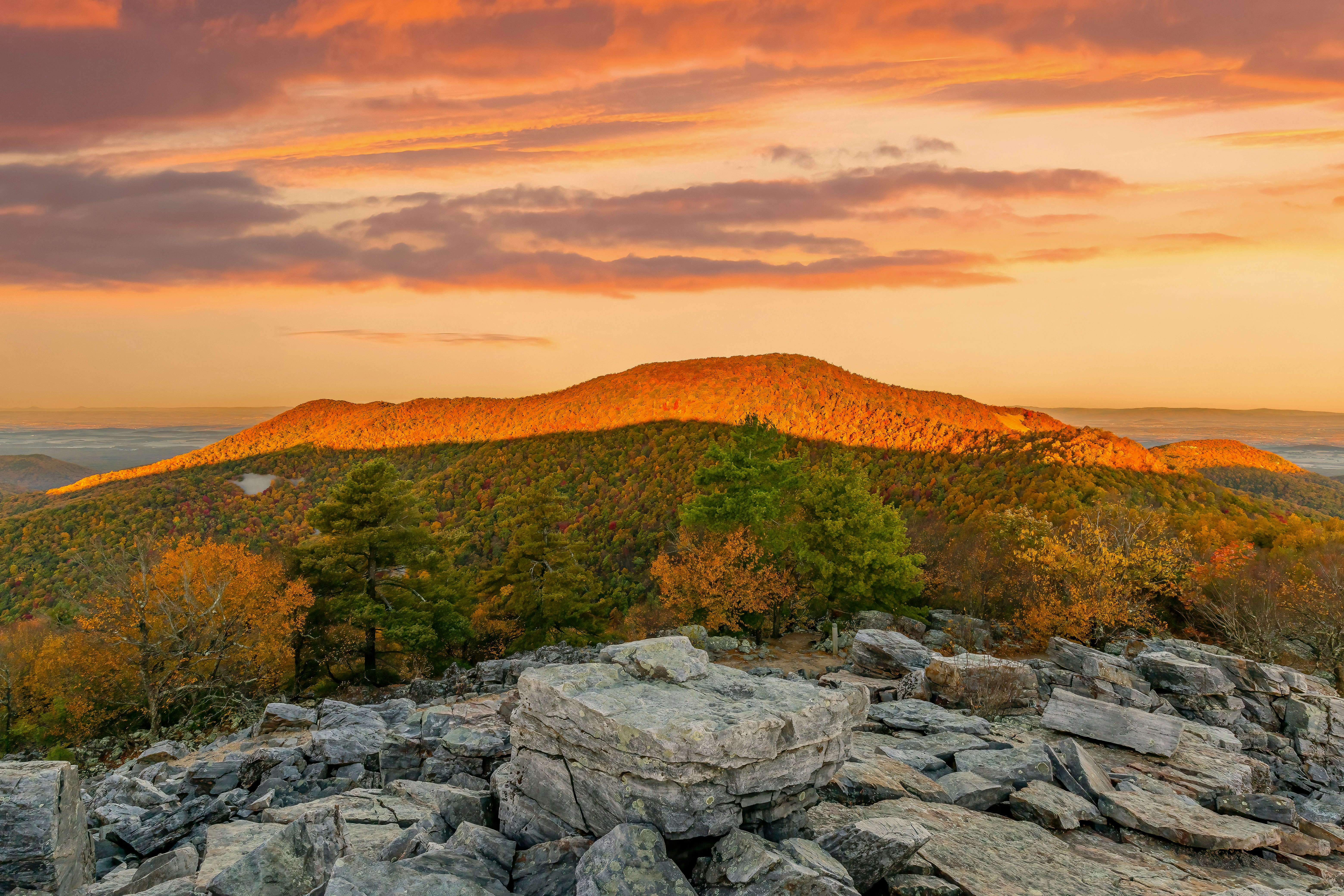
Route Overview
An East Coast classic that links Shenandoah, the Blue Ridge Parkway, and Great Smoky Mountains.
Itinerary
Skyline Drive and short summit hikes.
Skyline Drive - Panorama Overlook
Mile 41.7, just at the northern entrance to Skyland is the highest point on Skyline Drive at 3,680 feet. The highest point in Shenandoah is the summit of Hawksbill Mountain at 4,050 feet. Getting to the summit entails a relatively short hike of less than 2 miles.
Morning views across the Shenandoah Valley.
Great early light for photos.
Stony Man Trail
MILE 41.7 | Pets are not allowed on this hike. This enjoyable hike brings you to an outstanding view of the Shenandoah Valley, Massanutten Mountain, and beyond.
Short summit hike with wide views.
One of the best short hikes in the park.
Big Meadows area
Skyline Drive (mile 51) | Perched on top of a mountain, this high-elevation meadow can come as a bit of a surprise after the miles of lush, green forests that make up most of Shenandoah National Park. A must-see for every visitor, stop by Big Meadows to explore the trails, grab a bite to eat, or talk to a Ranger at Byrd Visitor Center.
Open meadows and frequent deer sightings.
Good spot for a picnic break.
More overlooks and waterfalls.
Hawksbill Summit Trail
Hawksbill Gap Parking Area (mile 45.5) | A shorter, yet steeper route to Shenandoah’s highest peak. The viewing platform on top of Hawksbill offers a magnificent 360-degree panoramic view of the Shenandoah Valley, the Blue Ridge Mountains, and the Virginia Piedmont.
Highest peak in the park with panoramic views.
Start early for cooler temps.
Dark Hollow Falls Trail
Dark Hollow Falls Parking Area (mile 50.7) | Pets are not allowed on this hike. This hike follows a stream to a beautiful waterfall, and is one of the Park’s most traveled trails. The trail is short, but very steep and rocky and the return hike is challenging!
Short waterfall hike with a steep return.
Take it slow on the climb back up.
Skyline Drive - Loft Mountain Overlook
Mile 41.7, just at the northern entrance to Skyland is the highest point on Skyline Drive at 3,680 feet. The highest point in Shenandoah is the summit of Hawksbill Mountain at 4,050 feet. Getting to the summit entails a relatively short hike of less than 2 miles.
Southern park overlook with sunset light.
Great final stop before leaving.
Drive a highlight section with overlooks and short trails.
Blue Ridge Parkway - Peaks of Otter
The Peaks of Otter has been a favorite stop for travelers for 8,000 years on their journeys across the mountains. Most have stopped along the banks of Stony Creek to refresh themselves with spring water, replenish their strength with a good meal, and rest in the cool shade of the forest. The Peaks of Otter picnic area offers creekside tables, charcoal grills, restrooms, and allows you the chance to become part of this millennia old traveler’s tradition.
Classic ridge views and short walks.
Linn Cove Viaduct
One of the most complicated concrete bridges ever designed and constructed, the Linn Cove Viaduct is a beautiful and inspiring stop along the Blue Ridge Parkway.
Iconic viaduct with a short trail.
Continue the Parkway toward the Smokies.
Cades Cove and key viewpoints.
Sugarlands Visitor Center
Wander through a cove hardwood forest with streamside views, rock walls, and historic stone chimneys on this half-mile (0.8 km) loop along a paved, flat trail. The trailhead is adjacent to a small parking area with several accessible spaces along Newfound Gap Rd (US 441) near Sugarlands Visitor Center.
Get oriented with current trail conditions, maps, and road updates.
Pick up the current parking tag and ask about waterfall flow levels.
Laurel Falls Trail
Hike 2.6 miles (4.2 km) roundtrip through a mixed hardwood forest to an 80-foot (24-m) waterfall. Enjoy a few views of the mountain landscape before arriving at the waterfall. PLEASE NOTE: Laurel Falls Trail is expected to close starting in mid-December for 18 months.
Classic Smokies waterfall hike on a paved trail.
Arrive early for parking; the trail gets busy by mid-morning.
Newfound Gap Overlook
A scenic high-elevation overlook with panoramic mountain views and a large parking area.
Iconic ridge view on the TN/NC line with wide mountain layers.
Bring a light layer; wind can be strong at the gap.
Clingmans Dome sunset
Clingmans Domer Tower provides a breathtaking view of the surrounding Smoky Mountains National Park. The Tower also has a story to tell - it was architecturally significant within the history of the National Park Service and a model for other towers that were built across the NPS.
Short walk to the observation tower for sunset views.
Bring a headlamp for the return; temps can drop fast.
Waterfalls and high-elevation overlooks.
Cades Cove Loop (sunrise)
Human history in Cades Cove started long before the 1800s. Humans have been using the land in this area for thousands of years. The earliest artifact collected in the park is a lithic dated to 7000 BCE. Though they may not have built structures in Cades Cove that are present today, the impact of the Cherokee is felt throughout the cove. Many trails created by the Cherokee are still traveled by visitors hiking or driving today. One of these trails is now Rich Mountain Road which connected the cove to the Tuckaleechee area. Many settlers followed in the Cherokees’ footsteps and used this route and others to reach Cades Cove. The Cherokee, like settlers after them, cut logs for structures and fires. They cleared land for agriculture, and they hunted, foraged, and traded or bought what they didn’t grow themselves. In the early 1810-1820s, Sequoyah developed the Cherokee syllabary, a written version of the Cherokee language. The Cherokee name for Cades Cove is Tsiyahi, “Otter Place.” Otters were found throughout the many creeks and streams in the cove, but they were extirpated from this area in the 1920s, after being hunted and trapped for their valuable pelts. The park reintroduced them in the 1980s and they have made a remarkable comeback. Today they are often seen near Abrams Falls. The name “Abrams” stems from Cherokee Chief Abram or Abraham, known as Ooskuah to the Cherokee. The origin of the name “Cade” also likely came from Cherokee Chief Cade (or Kade) from this area. A “cove” is a flat valley between mountains or ridges. Most of the Cherokee living in the Southeastern United States were forcibly removed starting with the Indian Removal Act in 1830 which offered territory in Oklahoma in exchange for land in this region. In 1835 the Treaty of New Echota ceded most of the Cherokee lands east of the Mississippi to the federal government. These actions resulted in the “Trail of Tears” in 1938, where 16,000 Cherokee were forced to walk 1,200 miles west. Thousands died in the process. The Eastern Band of the Cherokee who live on the Qualla Boundary adjacent to the park today are the descendants of the few who remained, escaped, or those who returned. A visit to Cherokee, North Carolina offers visitors an opportunity to learn more about Cherokee history and culture. Typically, when a national park or protected area is created, many spaces that people lived in and used are returned to nature. In Cades Cove, this idea is blended with historic preservation. Cades Cove has far fewer buildings than it did at peak settlement around 1900 with over 700 residents. Instead of agricultural fields, today there are grasses and native plants. The cove is actively managed using mowing and prescribed fire to keep trees and woody shrubs at bay. If the cove wasn’t managed this way, it would revert to forest in most areas and look very similar to the woods found throughout the park.
Wildlife-rich valley loop with historic cabins and open fields.
Enter at sunrise for the best wildlife viewing and light.
Abrams Falls Trail
Walk 5 miles (8 km) roundtrip through rhododendron, hemlock, and pine-oak forest to a 25-foot (7.6-m) waterfall and scenic pool. Swimming in the pool is not recommended due to slippery rocks and a dangerous undertow.
Moderate hike to one of the park's most impressive falls.
Trail is rocky; watch your footing near the river.
Cades Cove Picnic Area
A leafy 81-site daytime recreational area with tables, charcoal grills, restrooms, and a nearby camp store.
Shaded picnic break before finishing the loop.
Bring your own lunch; services are limited inside the cove.
Cades Cove historic cabins
A concession stable offering horseback-riding trips and rides through forests and meadows of Cades Cove.
Short walks to historic churches and cabins.
Stop at pullouts to avoid blocking loop traffic.
Return rental car and fly home.
Creates a copy you can customize
7
Days
16
Stops
moderate
Difficulty
Best Season
April-November with October for peak fall color
Tags